AI-generated illustration — not a retailer product photo.
Verdict
AI-generated illustration — not a retailer product photo.
Cliniko is a sensible product to shortlist for UK private practices that want a broad practice-management platform without paying separately for every receptionist, location, patient record or storage allocation. Its vendor-stated subscription model is based on practitioner numbers, while including unlimited locations, admin users, reception users, patients and file storage. A 30-day trial without payment details gives a clinic a practical way to test the fit before committing.
The strongest documented case is for practices that need to coordinate people and administration across one or more sites: role-based access, client communications, exports, referral-source tracking and an API are all part of Cliniko’s stated business-management range. That makes it especially worth investigating for allied-health and multidisciplinary operations.
It is not an automatic recommendation for every UK private practice. A clinic should first prove that its own specialty, insurer and billing workflow, payment setup, integrations and data-protection requirements work as required. Therapy practices in particular should assess whether a clinical-setting product fits their notes and client-management workflow.
What Cliniko Is
AI-generated illustration — not a retailer product photo.
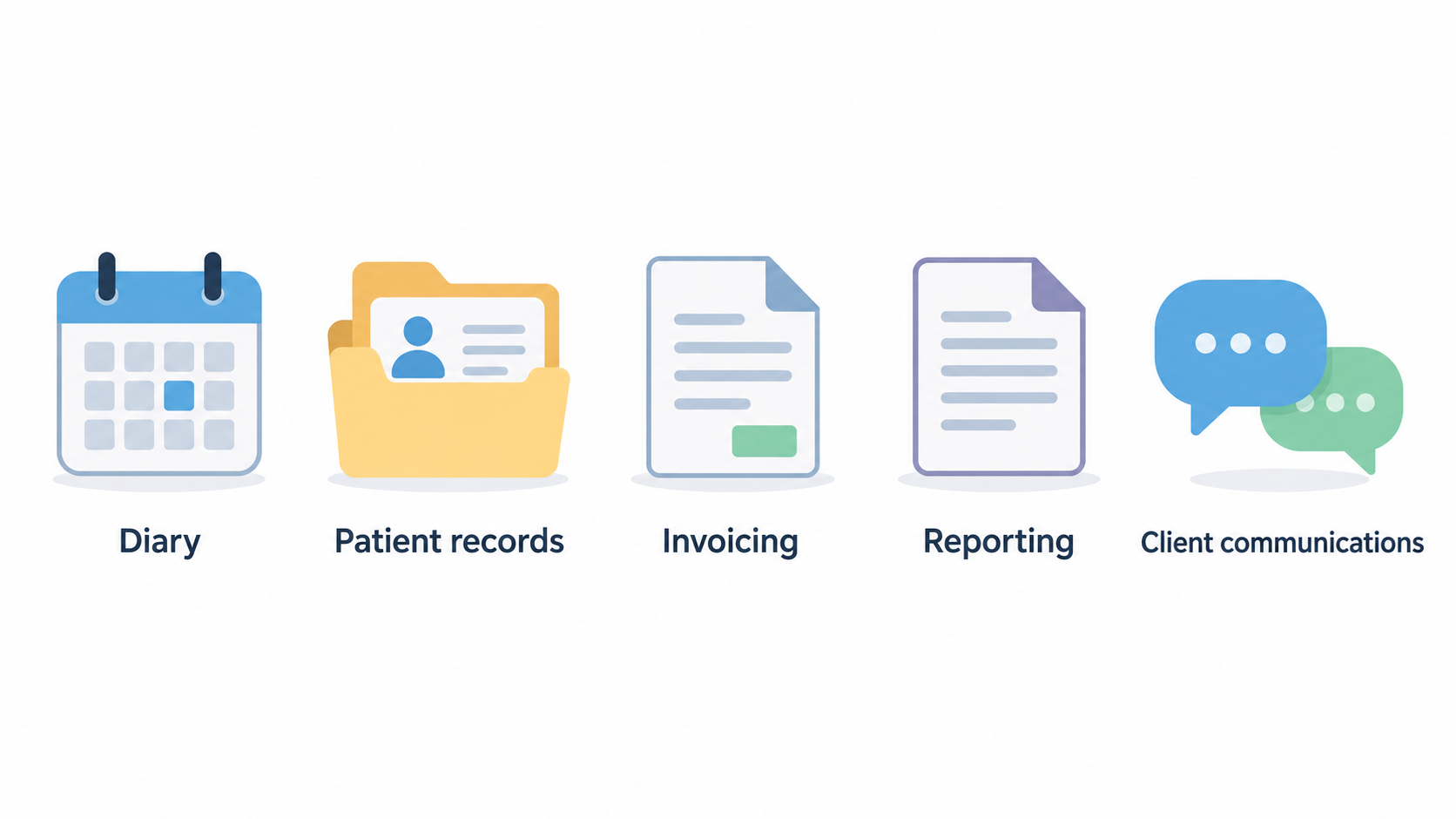
Cliniko is a practice-management software platform. In this category, the system commonly becomes the operational layer around a clinic’s diary, patient records, invoicing and reporting. The practical buying question is therefore not simply whether a platform has a long feature list, but whether it supports the way the clinic actually schedules, communicates, records information and gets paid.
Cliniko presents its business-management tools as a configurable set of functions for handling locations, staff access, client communications, data and integrations. Its official feature information describes separate clinic availability, practitioners and appointment types for multiple locations, alongside permissions for different user types.
That scope can suit an owner or operations team that wants a shared system rather than disconnected tools. It should not be read as evidence of hands-on performance in a particular practice. The relevant test is whether the configuration reflects the clinic’s specialties, service mix, rooms, practitioners and existing software.
Core Practice Management Capabilities
Cliniko’s documented business-management feature set covers several common administrative jobs. A practice can configure multiple locations with different availability, practitioners and appointment types. This is relevant where a group operates from more than one clinic, or where each site has different staffing and service patterns.
Security roles allow different user types to receive different permissions. In operational terms, that can help a clinic align access with responsibilities: reception staff, practitioners and administrators need not have identical access. The official feature page also states that unlimited admin staff can have individual logins, which may matter for teams with a large reception or coordination function.
For communication, Cliniko describes SMS messages, bulk SMS, a communication log and location-specific email addresses. Bulk messaging may be useful for operational notices such as an address change, while the communication log is intended to keep track of messages sent through the system, including reminders, invoices and letters. SMS credits are separate from the subscription, so message volume belongs in the cost check.
Data controls are another material consideration. Cliniko says users can export data stored in the system and download client data files. It also supports referral sources, which can help a practice track where clients come from, and provides an API for teams working with a developer on add-ons. These are capabilities to validate during a trial, particularly where reporting, migration or integration requirements are important.
Pricing and Scaling Considerations
Cliniko offers a 30-day free trial, and its official pricing page says no payment details are required to start it. After the trial, the subscription is based on the number of practitioners working at the clinic. The published prices are in US dollars, so a UK buyer should account for currency exposure and confirm the current commercial terms before signing.
The included allowances reduce some common scaling questions. According to Cliniko, every subscription includes all Cliniko features, unlimited admin users, unlimited reception users, unlimited locations, unlimited file storage and unlimited patients, alongside support, monitoring, updates and backups. In principle, this makes the commercial model more closely tied to practitioner count than to adding sites or front-desk accounts.
That does not make the total cost fixed. Cliniko states that SMS credits cost 10¢ per message, so clinics that rely heavily on reminders or bulk messages should estimate likely volume. A growing practice should also model how practitioner-band pricing changes as clinicians join or leave, then compare that result with vendors that charge per appointment or through other tiered structures.
Limitations and UK Due Diligence
The main limitation is not a documented lack of general administration tools; it is the risk of assuming that a broad platform will fit every specialist workflow. Independent UK-oriented commentary describes Cliniko as widely used by physiotherapists and allied-health practitioners, while characterising it as designed for clinical settings rather than talking therapies. That is a useful starting hypothesis, not a substitute for a workflow test.
Before purchase, a UK clinic should verify specialty fit. The selection criteria highlighted in independent editorial guidance include recurring appointments, treatment plans, group classes and funded care, all of which can vary substantially between physiotherapy, chiropractic, podiatry, psychology and multidisciplinary clinics. Ask staff to run realistic diary, record and follow-up scenarios rather than evaluating a generic demo.
UK billing and insurance need direct confirmation. A private practice may need support around Healthcode, VAT invoicing, direct debit or card payments; the appropriate combination depends on its business model and payer mix. Likewise, confirm how the product will connect to accounting, online booking, payment and other required tools. An API may be valuable, but it does not by itself prove that a required integration is available or affordable.
Finally, review data-protection obligations in the clinic’s own context. UK-focused therapy guidance points buyers toward GDPR compliance, ICO registration, session-note encryption and UK-based support as decision factors. Those criteria should be assessed against the practice’s risk, policies and supplier documentation rather than inferred from a general security claim.
Alternatives to Compare
Build the comparison set around the job that Cliniko must do for your practice. For an allied-health clinic, Cliniko is one option to evaluate alongside other products positioned for allied health. For a therapy or counselling practice, compare it with tools positioned specifically for therapists and counsellors, then test the notes, agreements, scheduling and client-communication workflow that staff will use every day.
If broader healthcare coverage is required, include general healthcare and medical-practice platforms in the shortlist. Independent editorial comparison lists alternatives across those categories, including Kiku for therapists, Semble for medical practices, Jane App for broader healthcare, and several allied-health or therapy-focused products. These labels describe positioning in that editorial source; they are not feature-by-feature equivalence claims.
UK-based product or support preferences can be a separate selection criterion. Independent therapy guidance distinguishes products by whether they are UK-based, while also urging buyers to evaluate pricing transparency, encryption and therapy-specific features. Treat that as a comparison prompt: confirm current ownership, support arrangements, hosting, contractual terms and functionality directly with every supplier.
The practical next step is to use the same scripted scenarios across shortlisted tools. Compare the pricing model, specialty workflow, scheduling, records, billing and insurance path, integrations, support and data-protection evidence. That produces a more reliable decision than choosing a nominal category winner.
How to Decide if Cliniko Fits
AI-generated generic editorial illustration — not a retailer product photo and does not depict the reviewed product or service. Give readers a scannable verification framework that separates documented Cliniko capabilities from UK-specific conditions they should confirm before purchase.
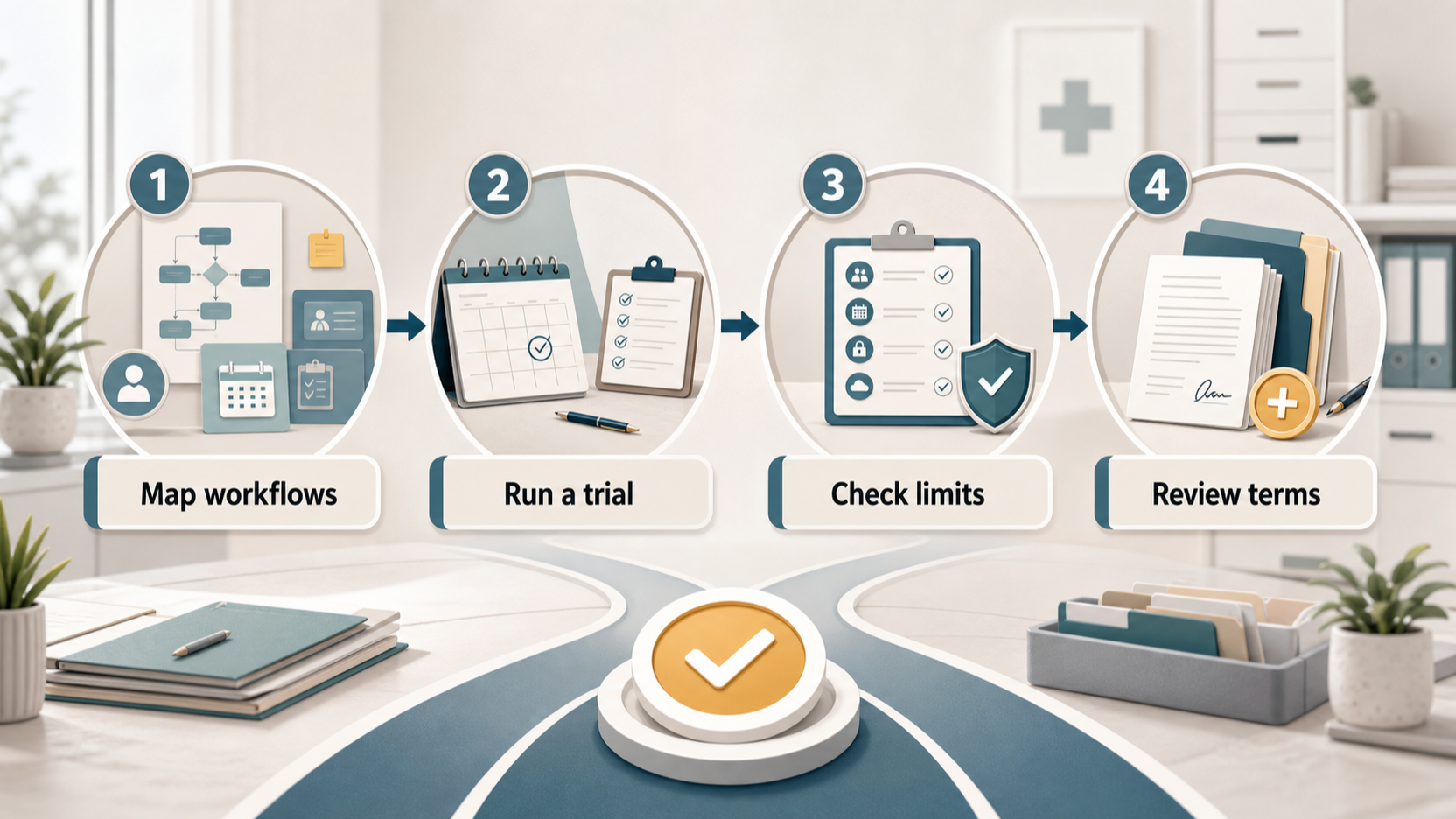
Start with the clinic’s operating model. Record the specialties served, number of practitioners, sites and rooms, appointment patterns, and the roles that need system access. Then map those needs to Cliniko’s documented range: location configuration, permissions, messaging, exports and API access. If a requirement is essential but not explicitly evidenced, make it a supplier question rather than an assumption.
Next, compare the commercial model. Model current and near-term practitioner numbers against Cliniko’s practitioner-based subscription, include expected SMS usage, and account for USD pricing. Compare that outcome with alternatives that charge per appointment or in different tiers. The goal is predictability for the clinic’s actual volume and growth path, not simply the lowest starting price.
Run a structured trial. Re-create a week of scheduling, use representative record and administrative workflows, test staff permissions, and check how the clinic would export information. Confirm the UK-specific path for billing, insurers, payments, accounting, online booking and any other required integration. Ask suppliers to answer data-protection, support and implementation questions in writing.
A positive result is evidence that the tool fits your practice—not evidence that it is universally best. If the trial exposes gaps in therapy-specific workflow, payer handling or integrations, compare a specialist alternative before making a commitment.
Frequently Asked Questions
Does Cliniko offer a free trial?
Yes. Cliniko’s official pricing page states that it is free to try for 30 days and that no payment details are required to start the trial. Use that period to test real clinic scenarios, not only a generic demonstration.
How does Cliniko charge private practices?
After the trial, Cliniko says its subscription is based on how many practitioners work at the clinic. Its published prices are in US dollars, and SMS credits are charged separately at 10¢ per message. Confirm current pricing and currency implications directly before purchase.
What is included in a Cliniko subscription?
Cliniko states that subscriptions include every Cliniko feature, unlimited admin and reception users, locations, file storage and patients, as well as support, monitoring, updates and backups. SMS usage remains a separate cost.
Is Cliniko suitable for UK therapy practices?
It may be worth comparing, but suitability requires direct testing. Independent UK-oriented commentary places Cliniko in allied health and describes it as built for clinical settings rather than talking therapies. Therapy practices should verify notes, client workflows, UK data-protection expectations, billing and support needs before deciding.
Sources
Related reading
- Best practice management software for UK private clinics: evidence-led top choices
- Cliniko vs Semble for UK private clinics: workflow, scale, and buying fit
- Semble review for UK private clinics: who it suits and what to verify
- WriteUpp review for UK therapists and clinics: features, costs, and fit
Editorial information: About our editorial team · Read our editorial policy · Read our affiliate disclosure.