Cliniko vs Semble: The Short Verdict
Neither platform is universally better for a UK private clinic. The more useful starting point is the operating model you need the software to support. Cliniko’s documented business-management features centre on multi-location setup, role-based permissions, staff communication, data exports and an API. That can make it a sensible candidate for clinics prioritising configurable administration across practitioners, reception teams and sites. Cliniko business management
Semble presents a broader integrated platform spanning an electronic health record (EHR), telehealth, scheduling, workflow automation, payments, data, migration and an API. On its own positioning, this may suit clinics that want to assess care delivery and business operations together. Semble Platform
For either product, shortlist fit should be tested against your specialty, billing requirements, current tools, implementation capacity and the workflows that create the most friction today. A long feature list is not a substitute for that validation. UK practice-management software guide
What UK Private Clinics Need From Practice Management Software
Practice-management software sits at the centre of the diary, patient records, invoicing and reporting, so the selection affects how a clinic runs day to day. For UK buyers, comparison should begin with the work rather than with vendor labels: a physiotherapy, psychology, podiatry or multidisciplinary clinic may need different support for recurring appointments, treatment plans, group activity or funded care. UK practice-management software guide
Map the practical criteria first. These commonly include multi-practitioner and multi-room scheduling, online booking, reminders and waitlists; the relationship between clinical records and administration; payment and accounting connections; reporting; and the availability of integrations or an API. UK billing and insurance processes also deserve direct scrutiny, including Healthcode, VAT invoicing and payment methods where they matter to your clinic. UK practice-management software guide
Cliniko and Semble should therefore be treated as practice-management candidates with different documented emphases, not as interchangeable checklists. Cliniko’s supplied product evidence foregrounds business administration. Semble’s supplied platform page foregrounds integrated care, scheduling and business-orchestration areas. Those positions are useful hypotheses for a demo, not proof that either product will fit every specialty or team. Cliniko business management Semble Platform
Where Cliniko Fits Best
 Cliniko’s documented business-management capability set is relevant when an administration layer has to work across people and locations. Its feature page describes multiple locations with different availabilities, practitioners and appointment types; permission-based security roles; internal staff messaging; client and wider data exports; communication logging; SMS and bulk-SMS tools; and an API for custom add-ons. Cliniko business management
That combination may be worth close attention for a clinic coordinating reception staff, practitioner access and communications across more than one site. The ability to separate user permissions and location setup can be especially important to test in the real responsibilities of managers, administrators and clinicians—not just in a generic product tour.
Cliniko may also be a sensible starting point for a team that wants to assess how a configurable administrative system can sit alongside its existing tools. Its API is documented as a route for developer-built add-ons, but an API alone does not establish that a required integration is already available or affordable. Ask the vendor to demonstrate the exact data flow and ownership model your clinic needs. Cliniko business management
Where Semble Fits Best
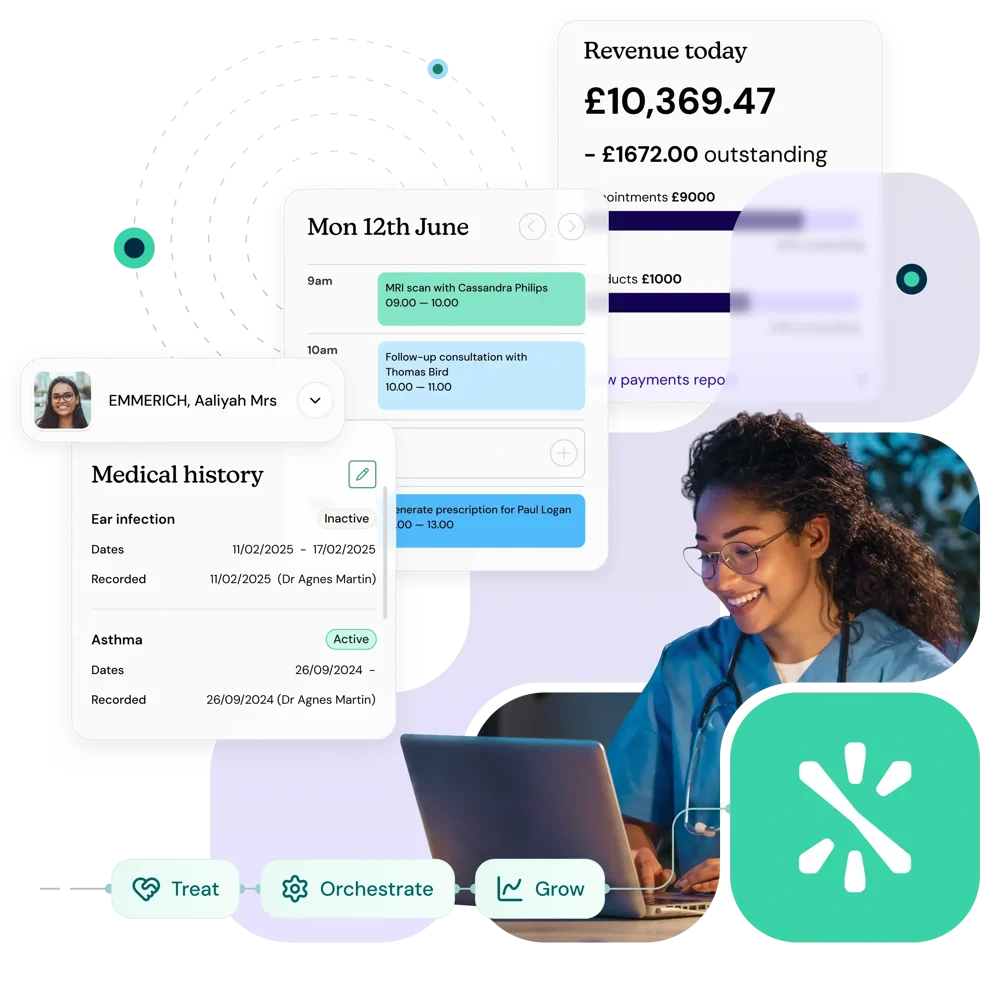 Semble positions its platform as one system to treat patients, grow the business and orchestrate care. Its supplied platform page lists an integrated EHR for consulting, prescribing and treatment, integrated telehealth, appointment scheduling, workflow automation through Semble Connect, payments, data, security and compliance, data migration, API documentation, and connections with labs, pharmacies and AI scribes. Semble Platform
This breadth may be most relevant to a private clinic that wants to examine clinical workflow, remote care, scheduling and operational processes as a connected evaluation rather than as separate software purchases. The page also presents offers by business size, including solo practitioners, corporate and occupational health, and enterprise contexts; that is vendor positioning, so buyers should validate it against their own care pathway and staffing model. Semble Platform
For example, a clinic considering telehealth, laboratory or pharmacy connections, business-tool automation, and payment workflows can turn each into a scenario for the demo. Confirm what is included in the proposed package, what requires implementation work, and how exceptions are handled. The supplied page establishes product areas, not independently verified performance, rollout effort or commercial value.
Limits and Due-Diligence Questions
Feature pages are useful for defining what to investigate, but they cannot settle suitability, implementation ease or total cost. A platform can list an API, integrations, migration support or multiple locations without proving that your required workflow is available in your configuration, works with your third parties, or can be adopted safely by your team. Cliniko business management Semble Platform
Use the evidence gaps as a demo checklist:
- Ask each vendor to run your complete patient journey: enquiry, booking, reminders, consultation, clinical record, invoice or insurer step, payment, follow-up and reporting.
- Verify specialty fit, including recurring appointments, treatment plans, group work or funded-care processes where relevant.
- Confirm UK billing, insurance, VAT, payment and compliance requirements directly for your clinic rather than assuming support from a broad product description.
- Test the integrations you actually use, including accounting, booking, payments and any clinical or communications tools.
- Request a migration plan that covers data scope, ownership, validation, downtime, training and exception handling.
- Compare commercial terms using your practitioner count, appointment volume, locations and expected implementation work.
These questions reflect the independent guidance that specialty, billing and existing tools are central to fit. They are not claims that either Cliniko or Semble lacks a particular function. UK practice-management software guide
Cliniko and Semble Compared by Buying Criteria
A defensible comparison uses the same questions for both vendors.
| Buying criterion | Cliniko: what supplied evidence supports | Semble: what supplied evidence supports | What to validate |
|---|---|---|---|
| Core workflow | Business-management features include staff communication, client communications and exports. | The platform lists an integrated EHR, telehealth and scheduling. | Walk through your specialty’s patient journey and exceptions. |
| Locations and teams | Multiple locations, differing availability and practitioner setup, security roles, and unlimited admin logins are documented. | The supplied page describes platform areas but does not establish the required multi-site configuration for your clinic. | Test roles, room or practitioner scheduling, reporting and handoffs by site. |
| Care delivery | The supplied Cliniko page is focused on business management. | Semble lists consulting, prescribing, treatment and telehealth within its EHR platform. | Confirm clinical documentation, consent, prescribing and remote-care workflows for your service. |
| Automation and integrations | Cliniko documents SMS, bulk SMS, communication logs and an API. | Semble lists automation, integrations with labs, pharmacies and AI scribes, plus API documentation. | Demonstrate each required connection, its data fields, failure handling and cost. |
| Data and implementation | Cliniko documents exports, including client data files. | Semble lists data, security and compliance, and data migration. | Review export scope, migration responsibilities, validation, access controls and contractual terms. |
This is not a scorecard with a predetermined winner. Cliniko’s documented strengths point toward administrative configuration across teams and locations; Semble’s documented scope points toward an integrated-care and operations evaluation. The appropriate choice depends on the workflows you prove in demos and reference checks. Cliniko business management Semble Platform
Alternatives Worth Shortlisting
Widen the shortlist when your clinic’s care model needs a more specialised evaluation. An independent therapy-focused guide distinguishes tools aimed at general healthcare, allied health, therapists and counsellors. It lists WriteUpp for general healthcare, Cliniko and Zanda for allied health, Kiku and Bloom for therapists, bacpac for counsellors, Jane App for broad healthcare, and PracticePal for allied health. Therapy practice-management software guide
That does not mean these alternatives are direct substitutes for Cliniko or Semble. It means a therapy-led, counselling-led or allied-health clinic should consider whether specialty workflows—not just general scheduling and payments—deserve to drive the shortlist. The same independent guide highlights criteria such as UK GDPR and ICO considerations, session-note encryption, pricing transparency, therapy-specific functionality and UK-based support for therapy and counselling practices. Therapy practice-management software guide
Keep the shortlist narrow enough for meaningful demos, but broad enough to prevent forcing a specialty requirement into a general-purpose choice.
A Practical Selection Process for Your Clinic
Start by mapping the current workflow and identifying the non-negotiables. Include the patient journey, roles, locations, systems of record, billing and insurance steps, clinical documentation, communications, reporting and integrations. Then separate must-have requirements from desirable improvements.
Next, run scenario-based demos with the same scripted cases for every shortlisted vendor. Ask staff from reception, clinical, finance and management to participate, because a system that works for one role can create friction for another. Independent UK guidance recommends evaluating specialty, billing and the tools already in use rather than selecting simply on feature-list length. UK practice-management software guide
Before signing, validate integrations and migration in writing. Cliniko documents exports and an API; Semble documents migration, integrations and API documentation. Those are starting points for questions about scope, responsibility, security, testing, timing and cost—not guarantees of a successful rollout. Cliniko business management Semble Platform
Finally, make staff adoption an explicit gate: agree training, test a pilot workflow where possible, define success measures and confirm commercial terms for your expected scale.
Frequently Asked Questions
Is Cliniko or Semble better for a small UK private practice?
Neither is automatically better. A smaller practice should compare the workflows it actually needs, its specialty, billing model, staff roles and existing tools. Cliniko’s documented business-management features and Semble’s documented integrated platform areas point to different evaluation angles, but a live scenario-based demo is needed to determine fit. Cliniko business management Semble Platform
Can Cliniko and Semble support multi-location clinic operations?
Cliniko explicitly documents multiple locations with different availabilities, practitioners and appointment types. Semble’s supplied platform evidence describes scheduling and a broad platform, but it does not establish the exact multi-location setup required by your clinic. Ask both vendors to demonstrate site-level access, calendars, reporting and handoffs. Cliniko business management Semble Platform
What should UK clinics verify about billing, insurance, and compliance before choosing software?
Confirm the precise billing, insurer, VAT, payment and compliance workflows that apply to your service. Independent UK guidance specifically identifies Healthcode, VAT invoicing and payment methods as areas to assess, while Semble’s platform page presents security and compliance as a product area. Direct vendor confirmation and contractual review remain necessary. UK practice-management software guide Semble Platform
How should a clinic test integrations and data migration before signing a contract?
Provide vendors with your real integration list and a representative data set or migration inventory. Demonstrate the required data flow, exports, permissions, reconciliation and exception handling; then document responsibilities, validation steps, timing and commercial assumptions. Cliniko documents exports and an API, while Semble documents integrations, migration and API documentation, but the practical outcome must be verified for your environment. Cliniko business management Semble Platform
Related reading
- Best practice management software for UK private clinics: evidence-led top choices
- Cliniko review for UK private practices: strengths, limits, and alternatives
- Semble review for UK private clinics: who it suits and what to verify
- How to choose practice management software for a UK private clinic
Editorial information: About our editorial team · Read our editorial policy · Read our affiliate disclosure.