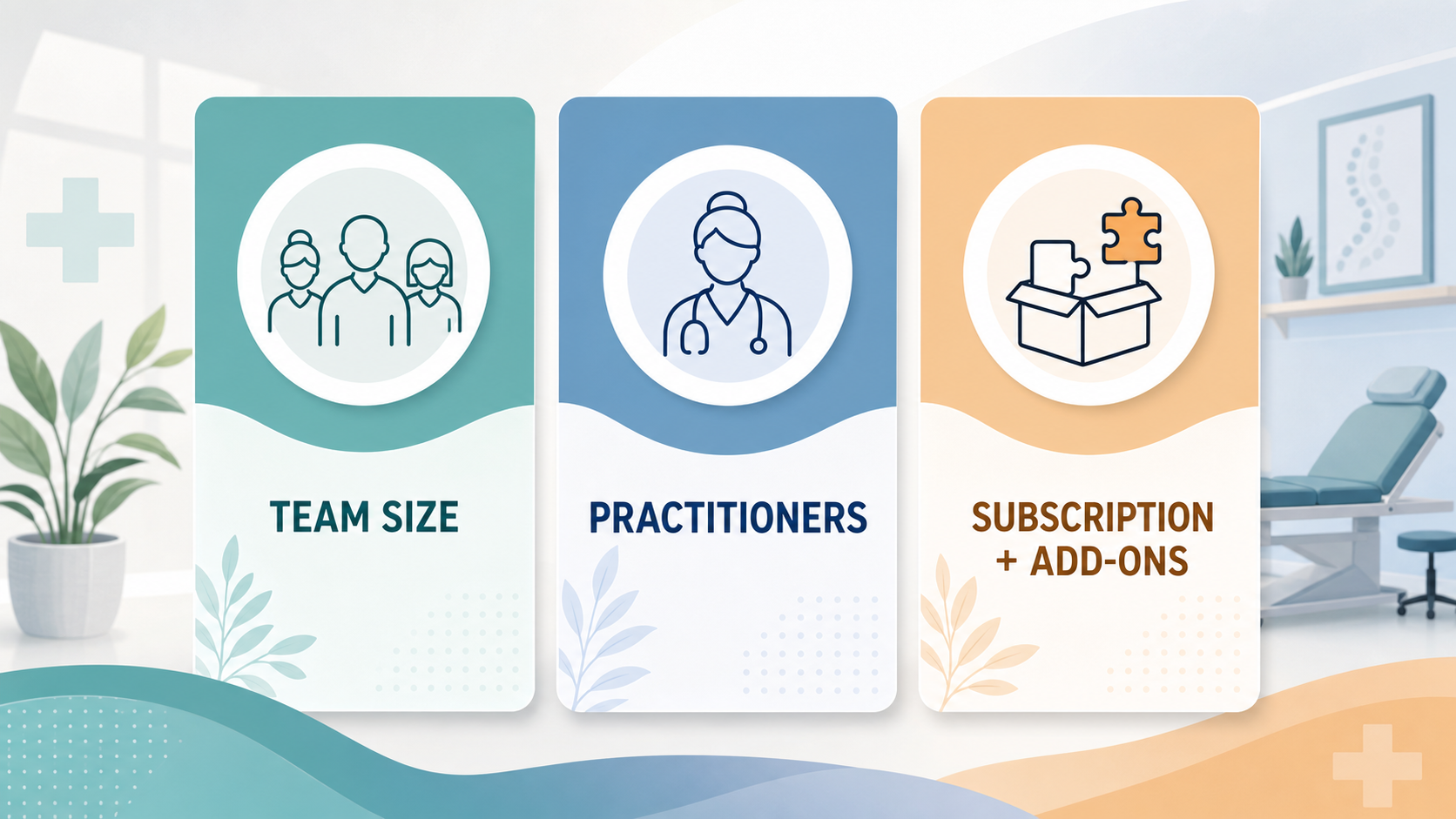
A free trial and a pricing page are useful starting points, but neither tells you whether a system will work well for your practice over time. Genuine value comes from proving the workflows your team relies on, understanding what the subscription unit actually covers, and checking the costs or limits that may sit outside the core plan.
What Genuine Value Means in Practice Software
AI-generated illustration — not a retailer product photo.
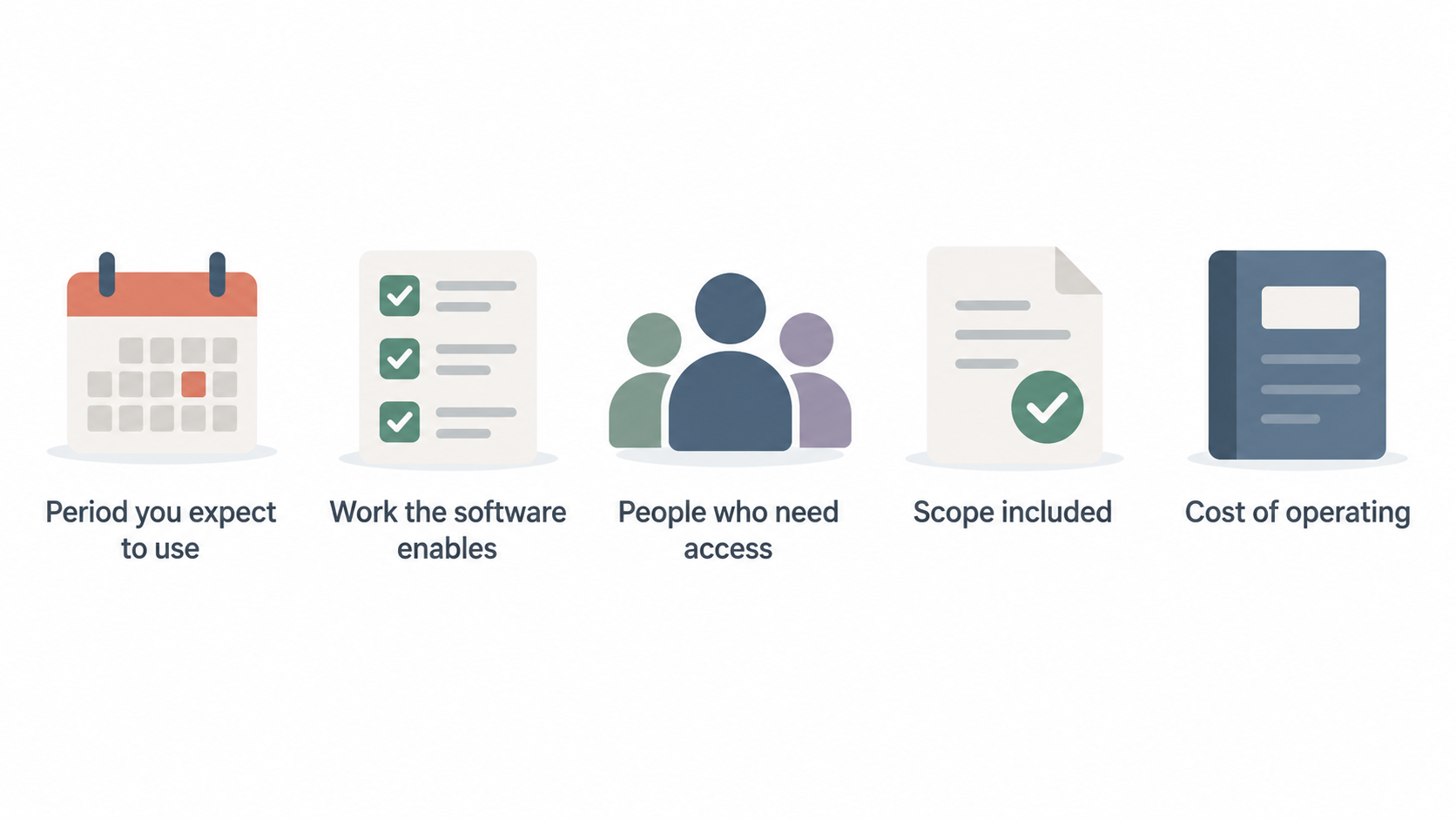
For a UK private practice, value is not simply the lowest displayed monthly figure. It is the relationship between the work the software enables, the people who need access, the scope included in the subscription, and the cost of operating it as the practice grows.
Start by defining the decision over the period you expect to use the product. A low initial subscription can be a poor fit if it creates extra administration, limits a key workflow, or requires paid services that the practice will use frequently. Conversely, a higher starting plan may be easier to justify when it includes the user access, records, booking, communications, reporting, or support your team needs.
The supplier’s pricing structure matters. Pabau says its pricing depends on location and number of users, with full platform access on every plan and optional add-ons available. Pabau pricing Cliniko describes a 30-day free trial and says subscriptions are based on the number of practitioners at the clinic, while listing unlimited admin users, reception users, locations, patients, file storage, and support as included. Cliniko pricing WriteUpp says a subscription includes full product access and online technical support subject to fair usage, but identifies several optional additional costs. WriteUpp subscription details
That is why a fair comparison starts with practice fit, not a headline price. Make a short list of the people, locations, workflows, communications volume, payments activity, and specialist capabilities that are genuinely in scope.
Test the Workflows That Matter During the Trial
AI-generated illustration — not a retailer product photo.
Treat a free trial as a structured operating check, not an extended product tour. Cliniko states that its trial lasts 30 days, requires no payment details, and is obligation-free; that creates an opportunity to test representative scenarios before a commercial commitment. Cliniko pricing
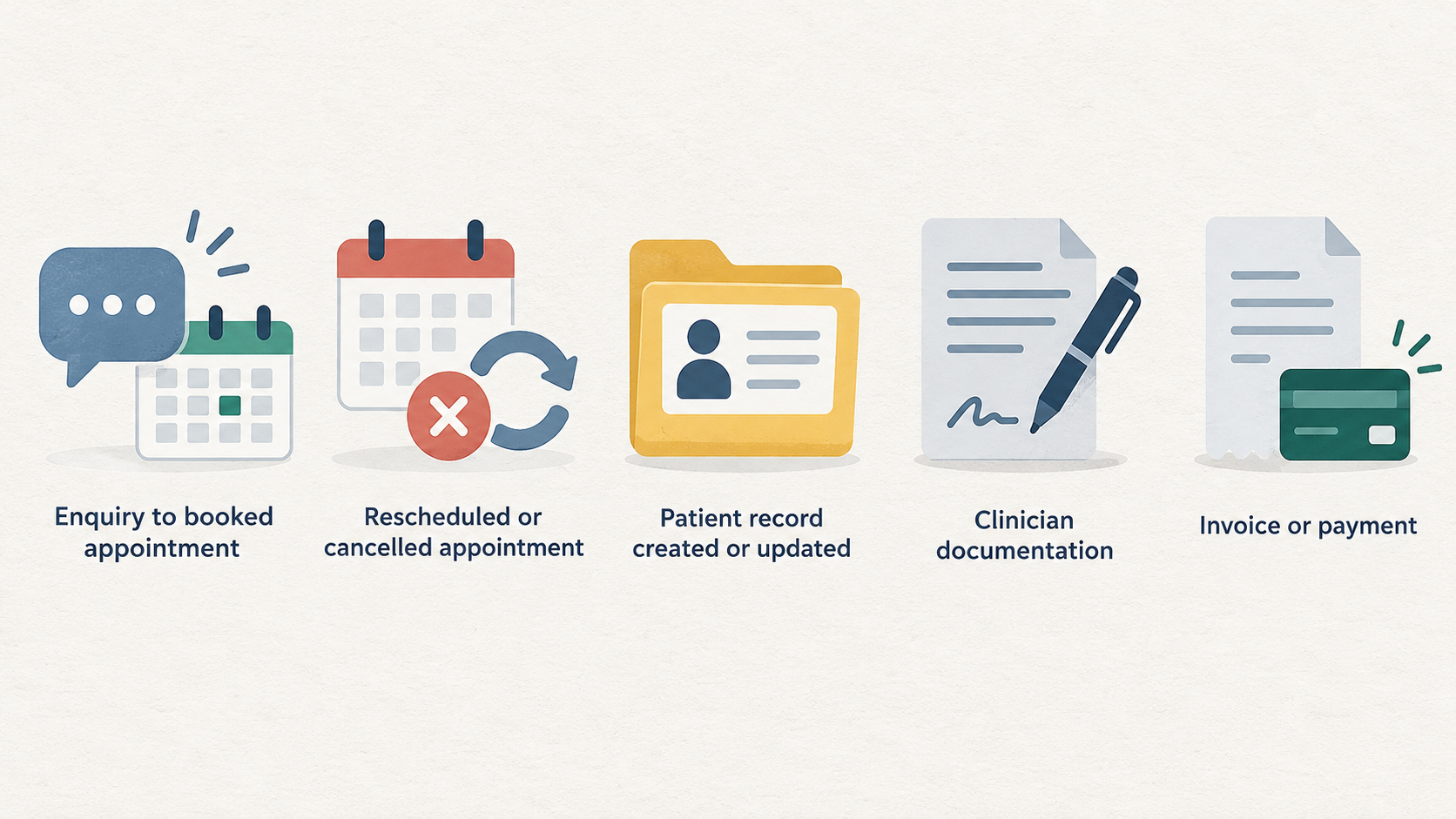
Build a test script from your own day-to-day work. Include a new enquiry becoming a booked appointment, a rescheduled or cancelled appointment, a patient record being created or updated, a clinician completing the relevant documentation, and an invoice or payment being handled where that is part of your process. If reminders, online booking, forms, room allocation, permissions, reporting, integrations, packages, or inventory matter to your practice, include realistic versions of those tasks too.
Use more than one role in the trial. A clinician, receptionist or administrator, operations lead, and the person responsible for finance or reporting can each expose different issues. The important question is not whether a feature exists in a menu; it is whether the people doing the work can complete the task with the controls and information they need.
Test access boundaries as well. Pabau describes team roles and permissions among the functionality included in every plan, while its plans are organised by user count. Pabau pricing Cliniko distinguishes practitioners from unlimited admin and reception users in its stated subscription inclusions. Cliniko pricing Your trial should therefore confirm which people need which type of account and whether the supplier’s pricing unit maps cleanly to your staffing model.
Record findings in a simple scorecard: scenario, user role, outcome, workaround required, unresolved question, and commercial implication. Do not rely only on a successful demonstration. A workflow that works for one person with sample data may still be unsuitable when several staff members, real appointment patterns, and established internal controls are involved.
Before the trial ends, review the scorecard with the decision-makers. Separate deal-breakers from items that need clarification, configuration, training, or a written commitment from the supplier. This makes the eventual decision traceable and reduces the risk of treating a polished first impression as evidence of long-term fit.
Read the Contract and Cost Boundaries Carefully
The core subscription is only one part of the commercial picture. Ask the supplier to confirm the current terms, plan inclusions, renewal conditions, payment arrangements, support boundaries, data and access arrangements, and any constraints that matter to your workflows. A pricing page can change, so use current supplier documentation and the proposed agreement for the final decision.
Check whether consumption-based services sit outside the subscription. Cliniko’s pricing page says SMS credits cost 10¢ per message. Cliniko pricing WriteUpp says SMS reminders require credit bundles after the first 20 included credits, although Solo and Group plans include some free monthly SMS credits. WriteUpp subscription details For a practice with regular reminder traffic, those details can materially change the operating cost.
Also identify optional capabilities and usage allowances. WriteUpp states that its subscription includes 1,000 video minutes for built-in one-to-one video consultations, with additional bundles available if needed; it also describes group video licences and AI Scribe licences as additional monthly per-user costs. WriteUpp subscription details This does not make those features poor value; it means the practice should estimate likely use before comparing plans.
Payment processing deserves its own line item. WriteUpp notes that Stripe can be used for invoice payments and online prepayment, and that Stripe charges transaction fees. WriteUpp subscription details Confirm the relevant payment arrangement, fee responsibility, and expected transaction volume rather than folding it silently into the platform subscription.
Finally, distinguish included platform scope from optional extensions. Pabau says every plan includes full platform access, while optional add-ons can extend the core subscription. Pabau pricing Put every required add-on, recurring credit purchase, licence, and third-party fee into the same comparison sheet so the approval is based on the likely operating setup, not the entry-level plan alone.
Compare Pricing Models on a Like-for-Like Basis
Pricing models can use different units, so a direct comparison of monthly figures is often misleading. Pabau says it is priced by team size and users, with plan bands from one user through to larger groups and enterprise use; its page also says pricing depends on location and the number of users needed. Pabau pricing Cliniko says its subscription is based on the number of practitioners, while including unlimited admin and reception users, locations, patients, and file storage. Cliniko pricing
Normalise each option against the same practice profile. List the number of practitioners, clinical and non-clinical users, locations, patients or records in scope where relevant, and the capabilities the practice requires. Then identify what is included at that level and what must be bought separately.
For example, a practice with several clinicians and a central reception team should not assume that a practitioner-based plan and a user-based plan will scale in the same way. It should calculate the appropriate quoted configuration for each supplier, then compare the resulting scope. The same applies to a single-clinician practice that depends heavily on text reminders, video consultations, online payments, or an optional AI service.
Include the billing basis and geography in your comparison. Pabau notes that its pricing varies by location, and Cliniko’s supplied pricing excerpt identifies its prices as USD. Pabau pricing Cliniko pricing For a UK buyer, obtain the applicable quote and confirm the currency, taxes, billing interval, and any applicable annual-plan conditions before drawing conclusions from displayed figures.
A practical worksheet has four columns for every supplier: the subscription unit, included scope, expected optional or usage costs, and the assumptions behind the estimate. Review it at today’s staffing level and at a plausible next-stage staffing level. This avoids declaring one model universally cheaper when the answer depends on how your practice is organised and which services it actually uses.
Use a Decision Process Before You Commit
AI-generated generic editorial illustration — not a retailer product photo and does not depict the reviewed product or service. Make the article's pre-commitment evaluation process easy to scan and follow.
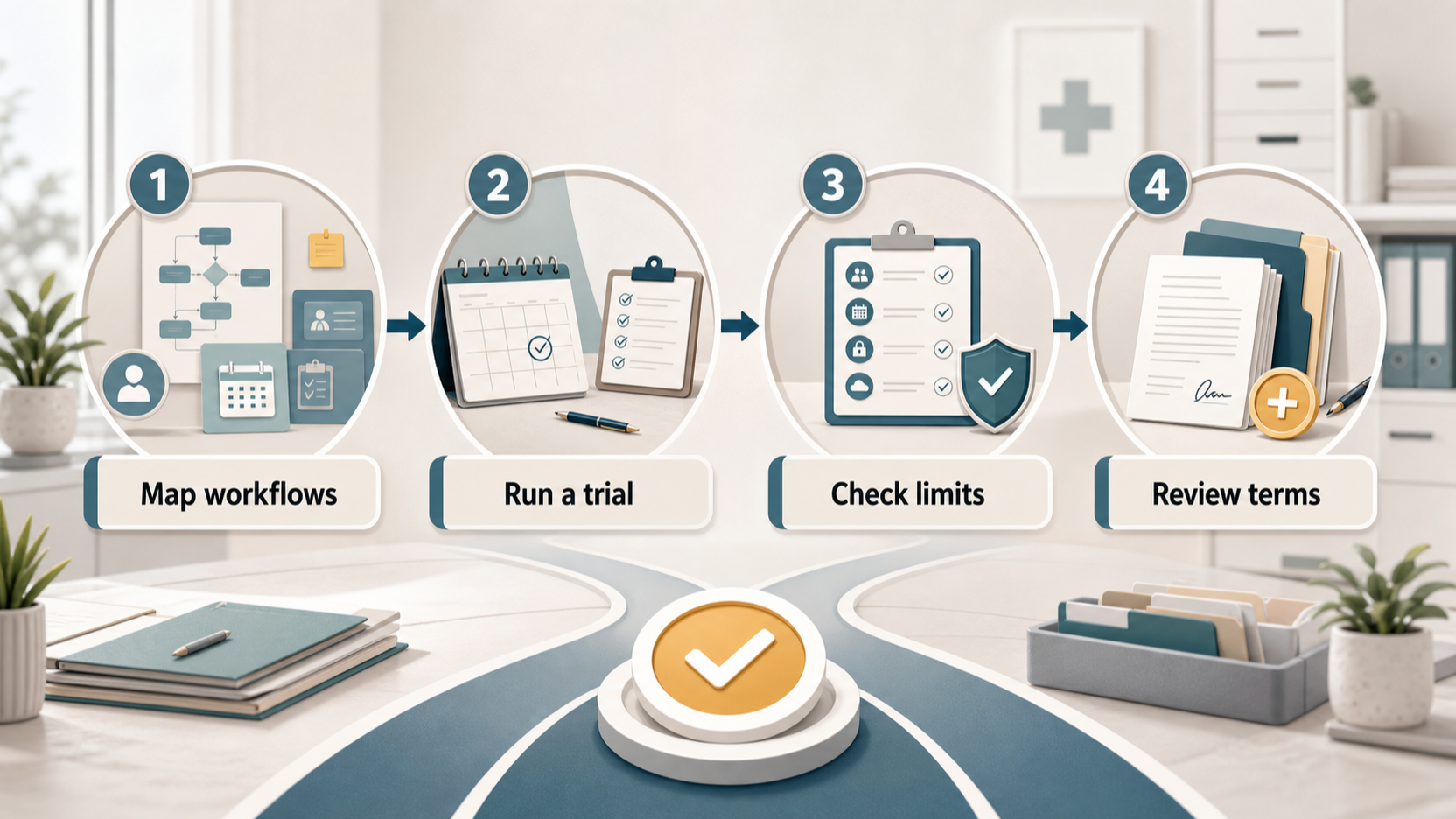 Use a repeatable sequence to move from shortlist to decision. First, map the workflows, roles, integrations, communications, payments, and reporting outcomes the system must support. Second, turn those needs into trial scenarios and assign owners to test them. Third, collect the commercial information needed to price the configuration you would actually run.
Give each stakeholder a clear responsibility. Clinicians should assess recordkeeping and consultation workflows. Operations teams should assess scheduling, access, rooms, communications, and day-to-day exceptions. Finance should review subscription units, payment-related costs, credits, add-ons, and the approval assumptions. Technical or data owners should review the access, integration, migration, and governance questions relevant to the practice.
At the end of the trial, hold a short evidence review. Confirm which scenarios were completed, which questions remain open, and whether any workaround changes the cost or risk of the proposed setup. Ask for written clarification where an included feature, usage limit, or optional charge is important to the decision.
Only then compare the supplier configurations on the same assumptions. Pabau’s stated model includes full platform access on every plan with optional add-ons; Cliniko’s stated model includes every feature with practitioner-based subscriptions and specified inclusions; WriteUpp identifies full product access alongside optional SMS, video, AI Scribe, and payment-related costs. Pabau pricing Cliniko pricing WriteUpp subscription details
The final go/no-go should be based on documented workflow fit, a current commercial proposal, and a clear owner for unresolved implementation tasks. That is a more reliable basis for commitment than a free trial alone.
Frequently Asked Questions
How long should a practice spend testing practice management software before committing?
Use enough of the available trial to run representative workflows with the people who will use the system. Cliniko states that its free trial is 30 days, but the right testing period depends on whether your practice has completed the relevant booking, record, communication, payment, access, and reporting scenarios. Cliniko pricing
Is pricing based on practitioners the same as pricing based on users?
No. The supplied sources describe different pricing units: Cliniko bases subscriptions on practitioner numbers, while Pabau says its pricing is based on users and team size. Cliniko pricing Pabau pricing Compare the quoted configuration for your actual mix of clinicians, administrators, reception staff, and locations rather than comparing a single displayed tier.
Which extra charges should a clinic ask about before signing?
Ask about services that may be usage-based, transaction-based, or optional. The supplied sources specifically identify SMS credits, video-minute bundles, group video licences, AI Scribe licences, optional add-ons, and payment-processing fees in relevant contexts. WriteUpp subscription details Confirm the current terms and your expected usage with the supplier.
Can a lower monthly subscription still cost more over time?
Yes. A lower core subscription can produce a higher overall cost for a particular practice if it requires paid credits, additional licences, optional add-ons, payment fees, or operational workarounds that the alternative does not. The comparison should therefore include the configuration and usage assumptions your practice expects, not only the initial subscription figure.
Related reading
- How to choose practice management software for a UK private clinic
- Practice management software data protection and security checklist for UK clinics
- How to budget for practice management software: total cost of ownership for UK clinics
- Best practice management software for UK private clinics: evidence-led top choices
Editorial information: About our editorial team · Read our editorial policy · Read our affiliate disclosure.